Desert landscaping in 2027 is less about survival and more about owning the look. These 28 ideas show how to turn a dry zone into a garden that feels intentional, not barren. You will see layouts, plant choices, and hardscaping that work with the climate instead of fighting it.
Each photo in this collection focuses on a real outdoor space. The goal is to give you practical options for your own yard, from a single agave in a concrete planter to a full xeriscape with boulders and cacti. No invented trends, just what is actually growing.
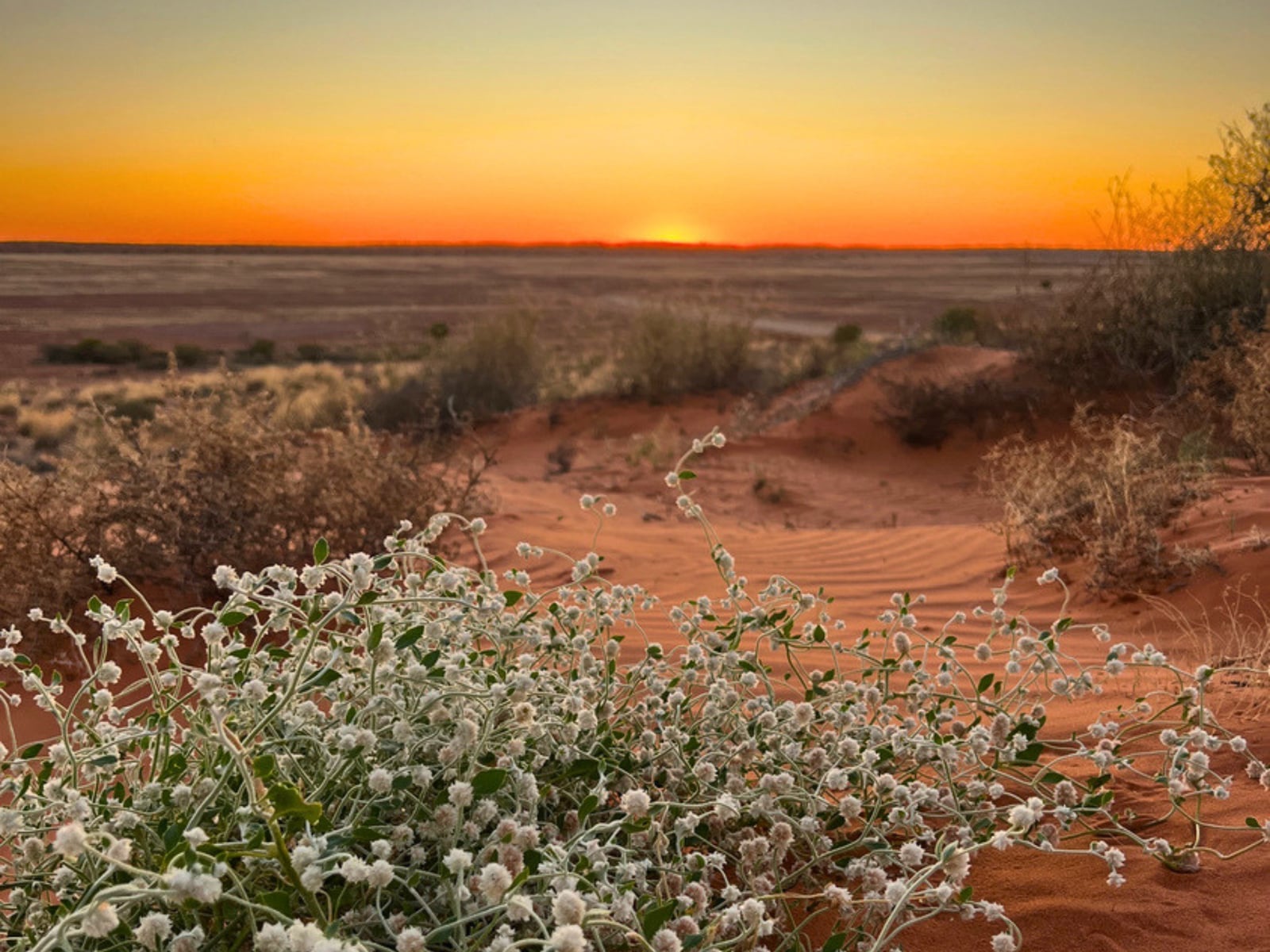
Sunset glow on undulating dunes with delicate ground cover
The last light turns sand dunes into a warm orange and yellow canvas, and the dry brush that seemed dull an hour ago now holds its own against the glow. Small white flowers push up through the gravel, softening the whole scene. This is a backyard that answers the question of what to do with a wide, open space: let the land set the palette and tuck in flowering ground cover where it can catch the low sun. The layout keeps the dunes as the main event and plants as accents, which is exactly what a natural desert look needs.
Serene xeriscape featuring a prominent eucalyptus tree
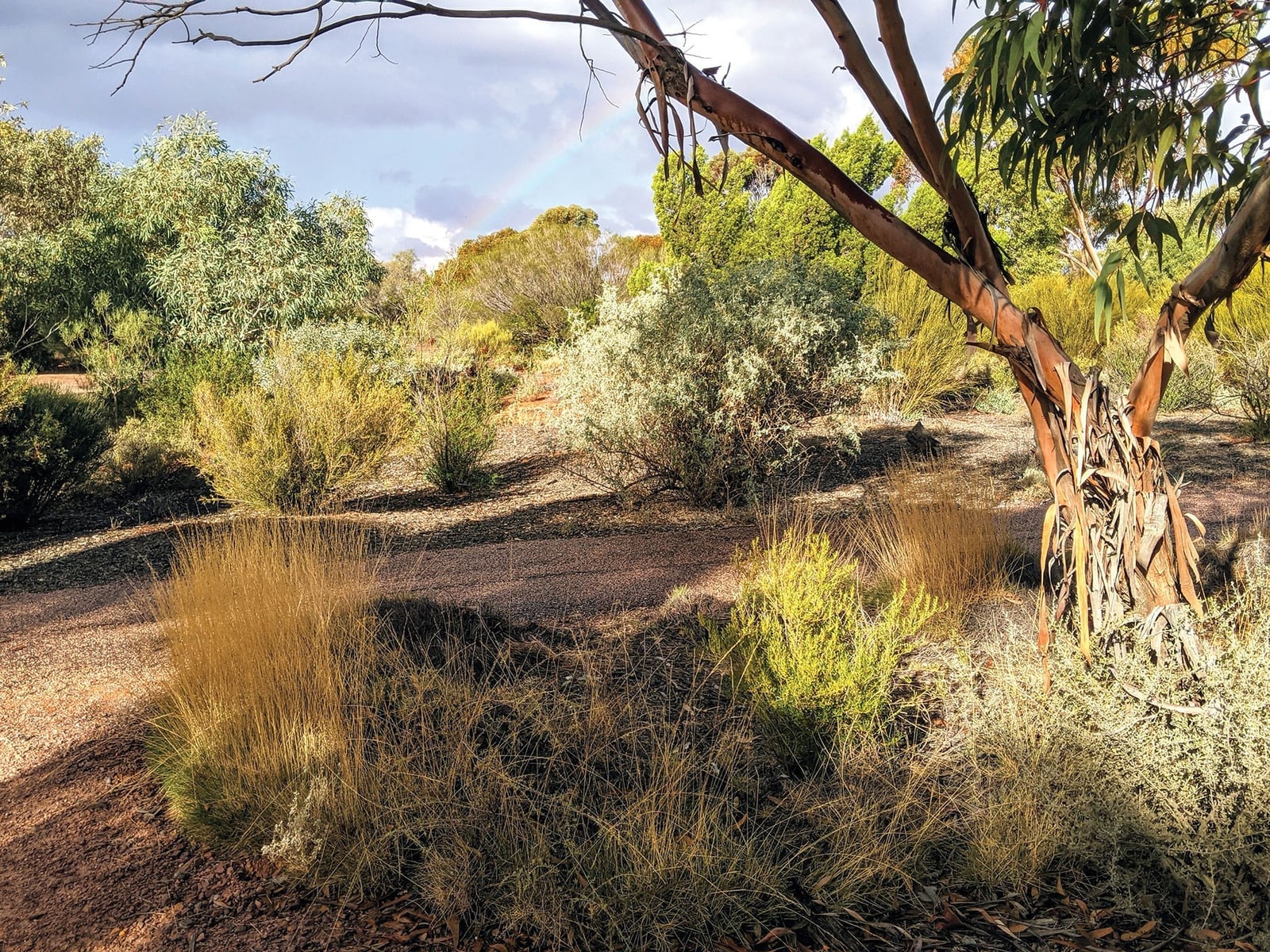
A eucalyptus tree anchors this xeriscape with its peeling bark and soft gray-green leaves, and a rainbow cutting through the dappled light makes the whole garden feel like a lucky break. Native shrubs and ornamental grasses fill in the space below, while gravel paths curve around the planting beds. The palette stays in greens, browns, beige and sky blue, which keeps the eye moving without any single color shouting. The tree becomes the hero element because everything else, the dry grass, the bark mulch, the low shrubs, steps back and lets it stand out.
Modern desert garden with a dry creek bed pathway
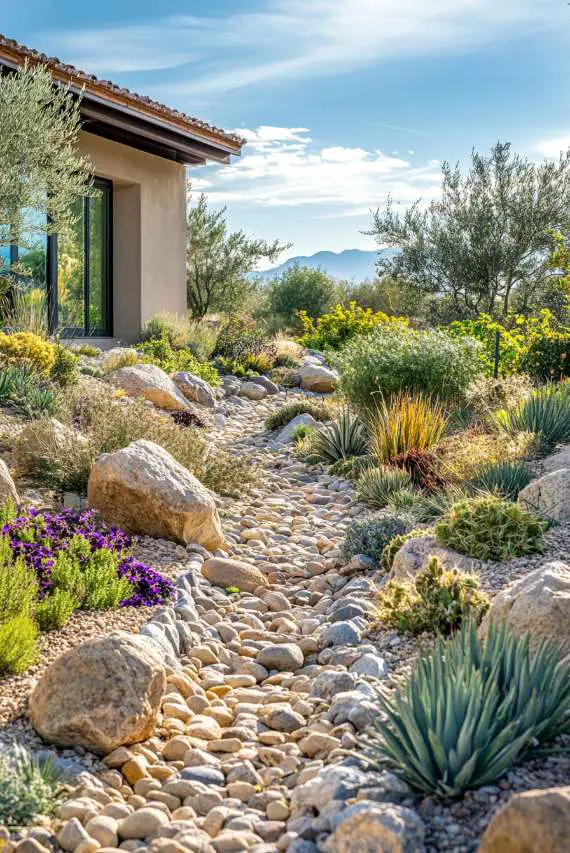
A dry creek bed built from river stones winds through this xeriscaped garden, bordered by agave, olive trees and boulders. The stones come in varied sizes, which keeps the bed from looking a single flat stripe, and the tan gravel between them matches the stucco wall behind.
Agave plants add sharp green forms on either side, while purple and yellow flowers break up the earthy palette. The creek bed does double duty: it guides foot traffic and channels runoff, which means less standing water after a storm. For anyone in a dry climate who still gets the occasional downpour, this is a material choice that solves two problems at once.
Geometric planting beds with barrel cactus and agave
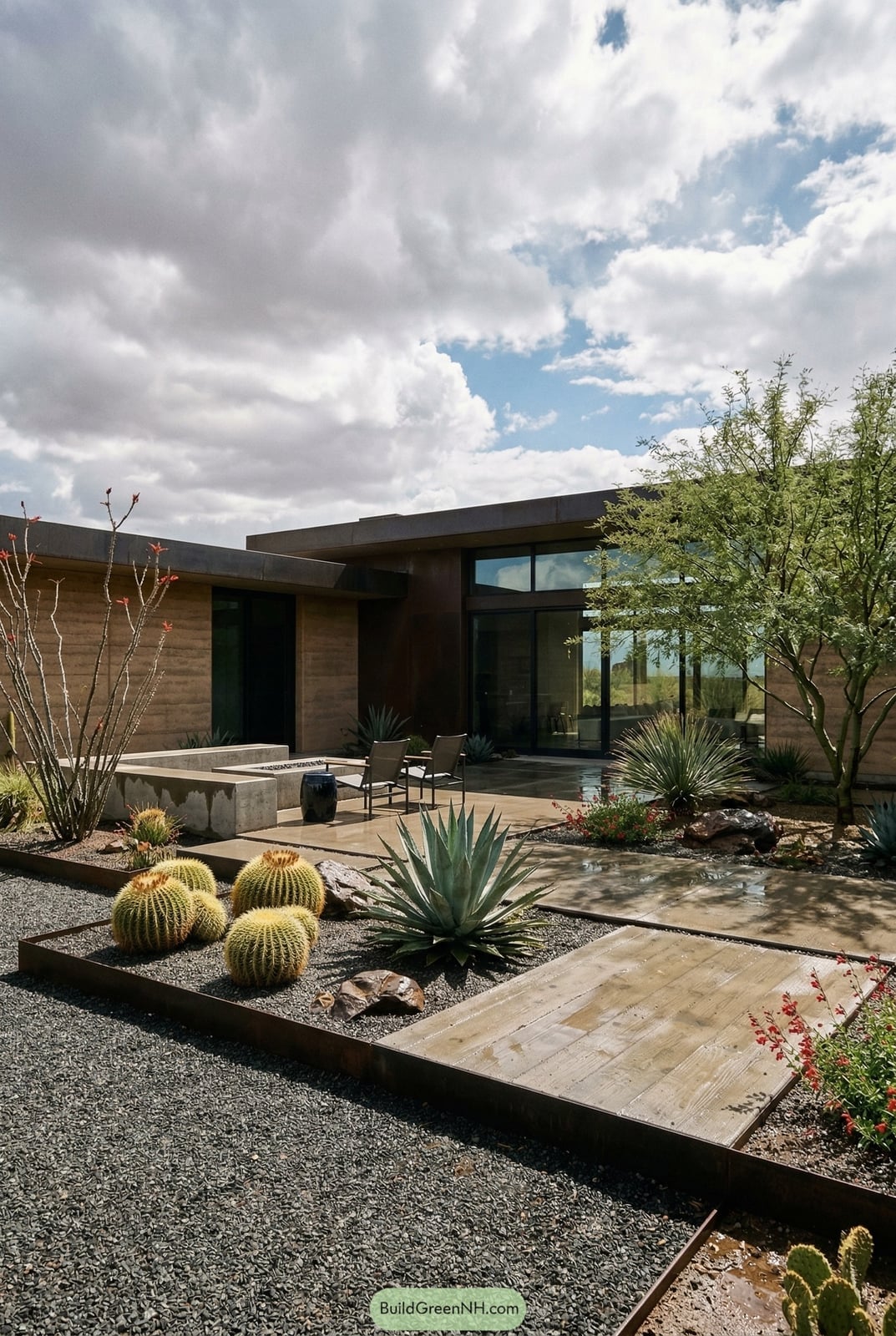
A large agave plant sits at the center of a geometric bed framed by concrete and metal edging, with barrel cactus repeating the round form in smaller doses. The paved walkways in gray concrete and beige gravel create clean lines that contrast with the spiky plants. A palo verde tree nearby adds filtered shade and a soft green canopy. The layout puts the agave front and center, and the repeated circles of the barrel cactus echo its shape without competing. Chairs placed along the walkway turn the planting bed into something you can look at from a seated position.
Naturalistic desert planting with saguaro cacti and boulders
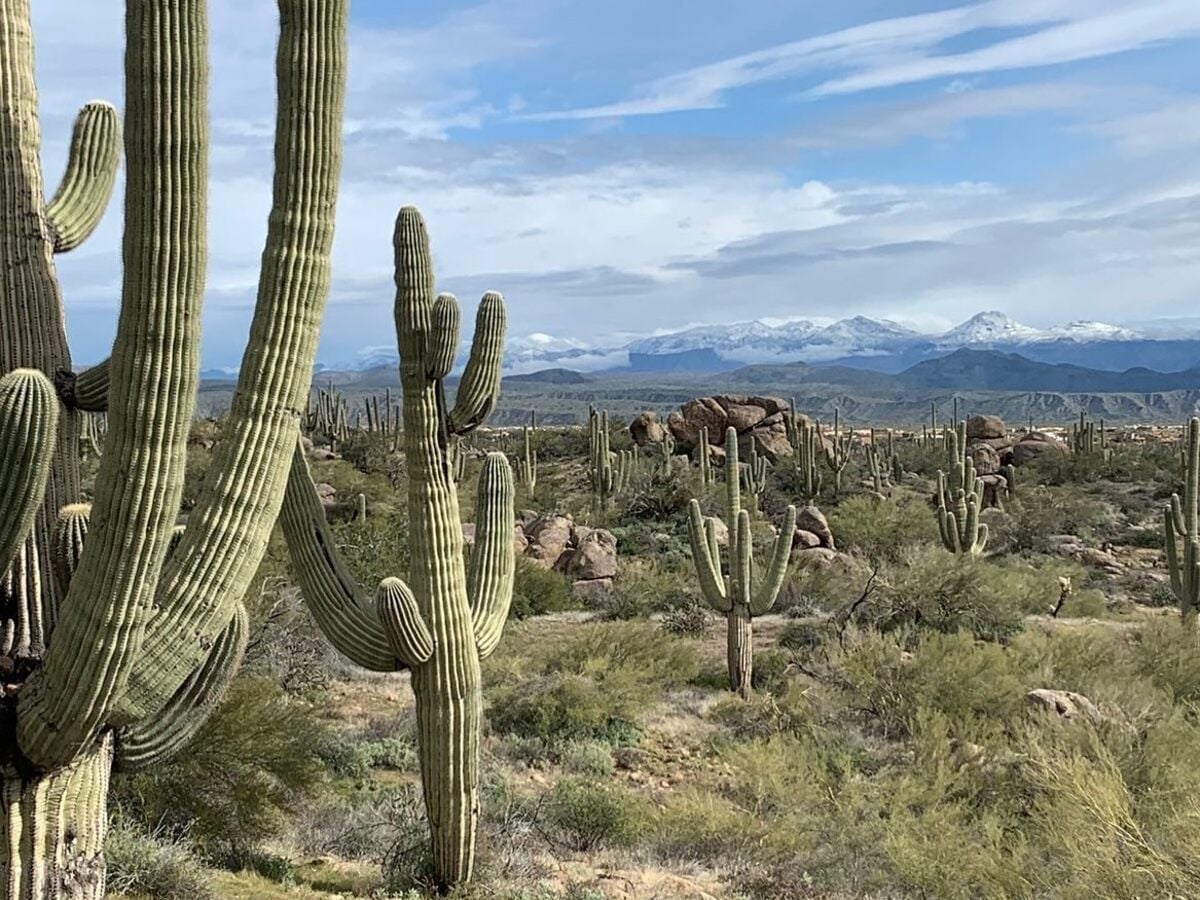
A practical rule for desert planting: place the tallest pieces first, then build downward. Here, saguaro cacti rise against a backdrop of snow-capped mountains, with boulders and low desert shrubs filling the ground plane. The blue sky and white peaks balance the brown and green of the plants, so the whole view feels larger than the yard itself. The style looks desert modern because the planting is naturalistic but the spacing is deliberate. Nothing crowds, nothing gaps. What breaks the look is the mountain view, which is not something you can plant, but the boulders come close to replicating that scale at ground level.
Desert modern backyard with large agave and palm tree
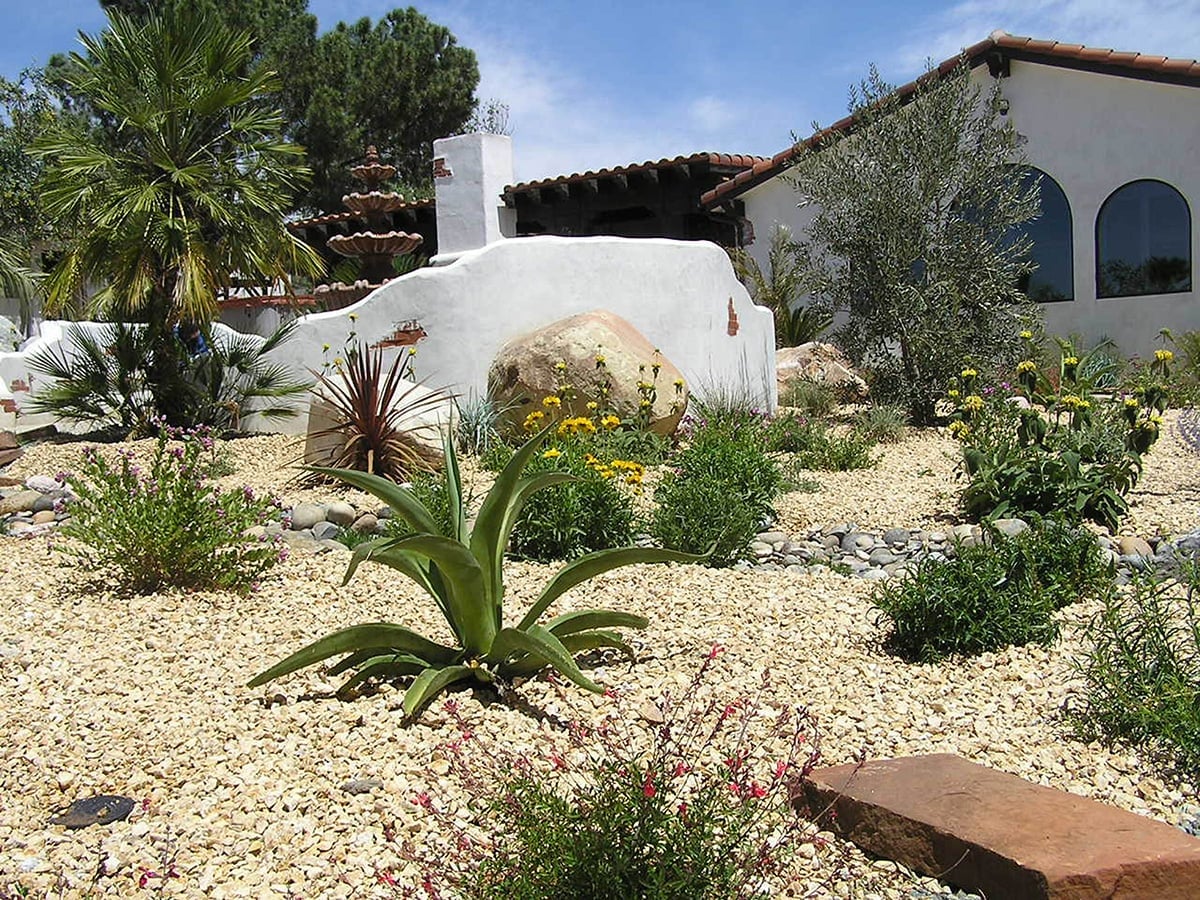
A pool and a lawn are the usual suspects for a backyard, but this setup swaps both for something that needs less water and less work. The large agave in the foreground and the palm tree behind it set two different heights, which gives the space a natural rhythm without any fussy pruning. A small fountain adds the sound of moving water without the upkeep of a full pool. The terracotta roof on the house ties into the warm tones of the gravel ground cover, making the whole yard feel connected to the house rather than separate from it. For a backyard that gets full sun and you want to actually use, this layout proves that a few well-placed plants and a single water feature can handle the job.
Layered succulent and cacti garden with natural stone accents
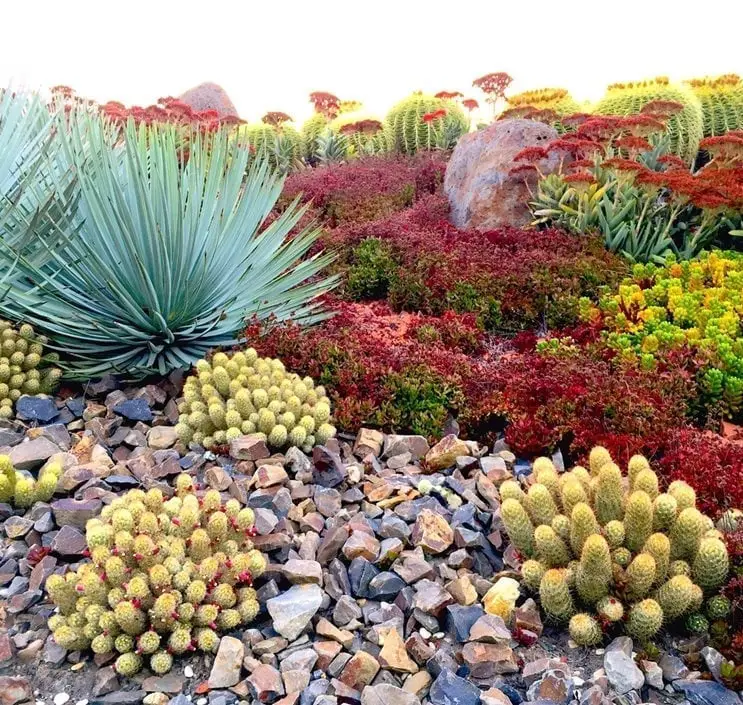
The blue agave sits at the back, barrel cacti and bunny ear cacti fill the middle, and smaller succulents spread out near the front. That front-to-back layering means every plant gets its own space and its own light, which matters when you are working with a yard that gets intense afternoon sun. The natural stone accents break up the gravel and give the eye a place to rest between the greens and blues. If you rent, this whole look can travel with you in pots arranged at different heights rather than planted in the ground.
Aloe tree anchors modern backyard with flagstone path
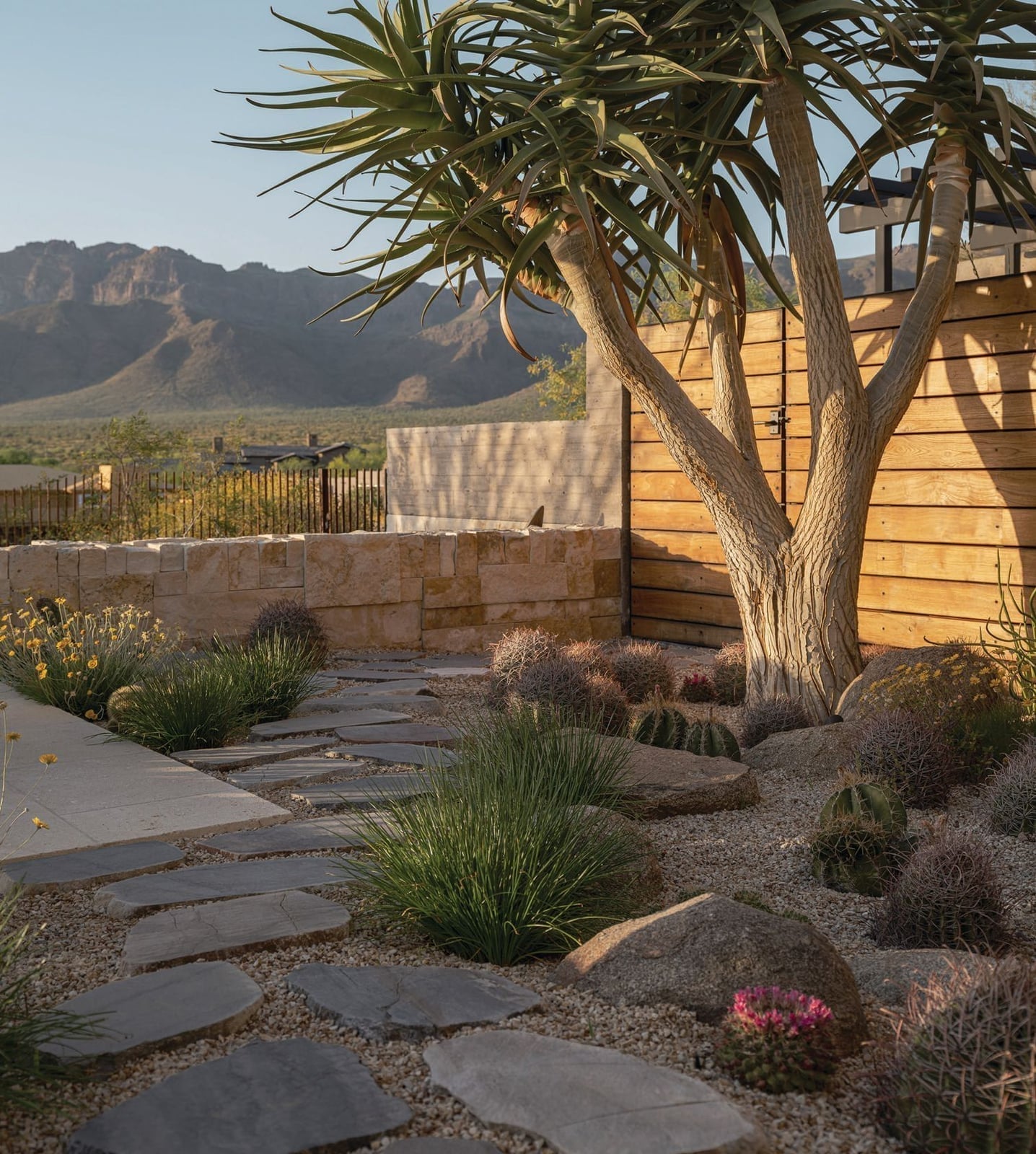
This is a yard that lets one plant do the heavy work. The aloe tree, with its thick trunk and upward reach, anchors the whole space, and everything else falls into place around it. A winding flagstone path cuts through the gravel, leading from the patio out toward the cacti and shrubs at the edges. The path keeps your feet clean and gives the garden a clear route to follow, which is useful if you actually walk through this space rather than just look at it from the house. Golden hour light catches the tree trunk and the stone, warming up the tan and gray palette. For a backyard that needs a focal point but does not have room for a shade tree, an aloe tree is a smart substitute.
Rustic metal planters featuring spiky yucca plants
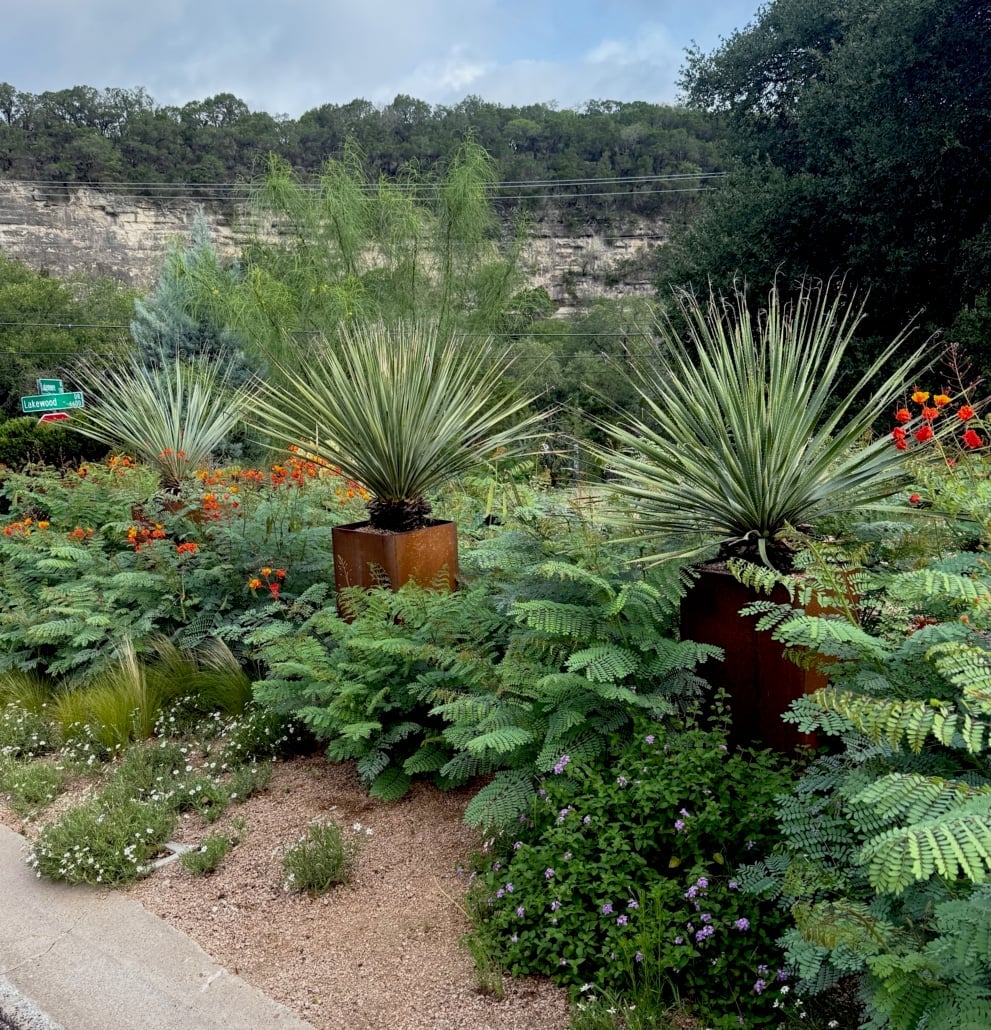
Can you get the sculptural look of yucca without committing to a permanent planting bed? Yes, and the answer is a metal planter. The large spiky yucca plants here sit in rustic metal containers, which means they can shift around as the sun moves or as you change your mind about the layout. The orange, red, and purple tones from the flowering bushes nearby soften the sharp lines of the yucca leaves, so the whole grouping looks balanced rather than aggressive. Metal planters also handle the heat better than plastic or ceramic, which matters when temperatures climb and you do not want to replace cracked pots every season. The gravel base underneath keeps drainage simple and stops mud from splashing up onto the metal sides.
Linear planting bed with agave, euphorbia, and red flowers
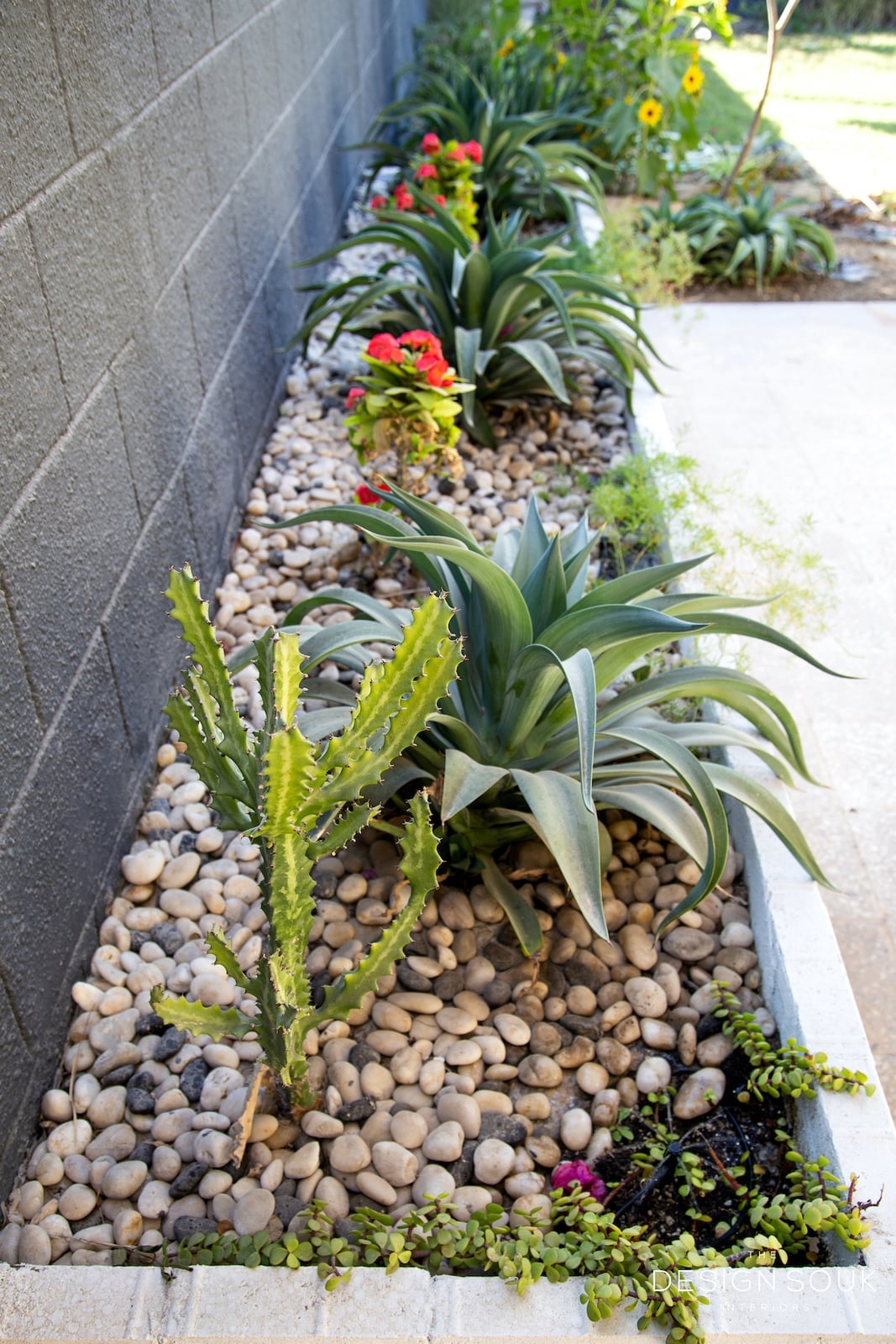
This planting bed runs in a straight line along the edge of a concrete patio, and that clean geometry gives the space a deliberate, structured look. The agave and euphorbia provide structure with their upright forms, while the red flowers add a bright accent that draws the eye down the length of the bed. The gray concrete and beige gravel keep the palette neutral so the green and red can stand out. For a compact backyard, a linear bed like this uses the perimeter to create depth without taking up floor space you might need for seating.
Textured ornamental grasses along a concrete pathway
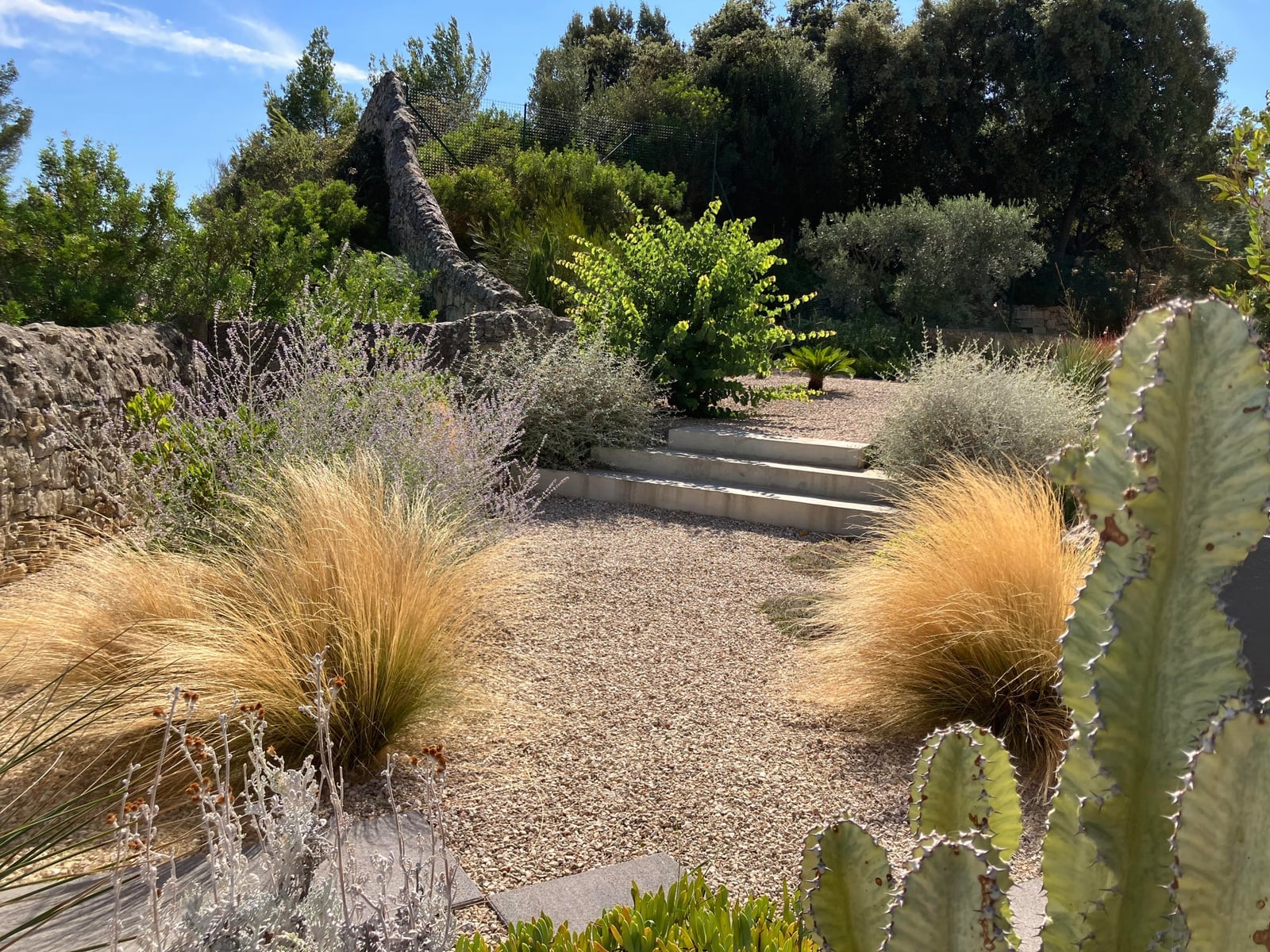
In a modern desert garden, fluffy golden ornamental grasses soften a run of concrete steps, their texture breaking up what could be a hard line. Low succulents and a stone wall anchor the scene, keeping the palette in greens, beiges, grays, and a whisper of light purple. The layout feels spacious because the planting stays layered instead of crowded. To recreate it, look for one standout grass variety and repeat it along the walkway instead of mixing too many species. The repetition gives the eye a rhythm to follow.
Large round planters with ornamental grasses and flowering plants
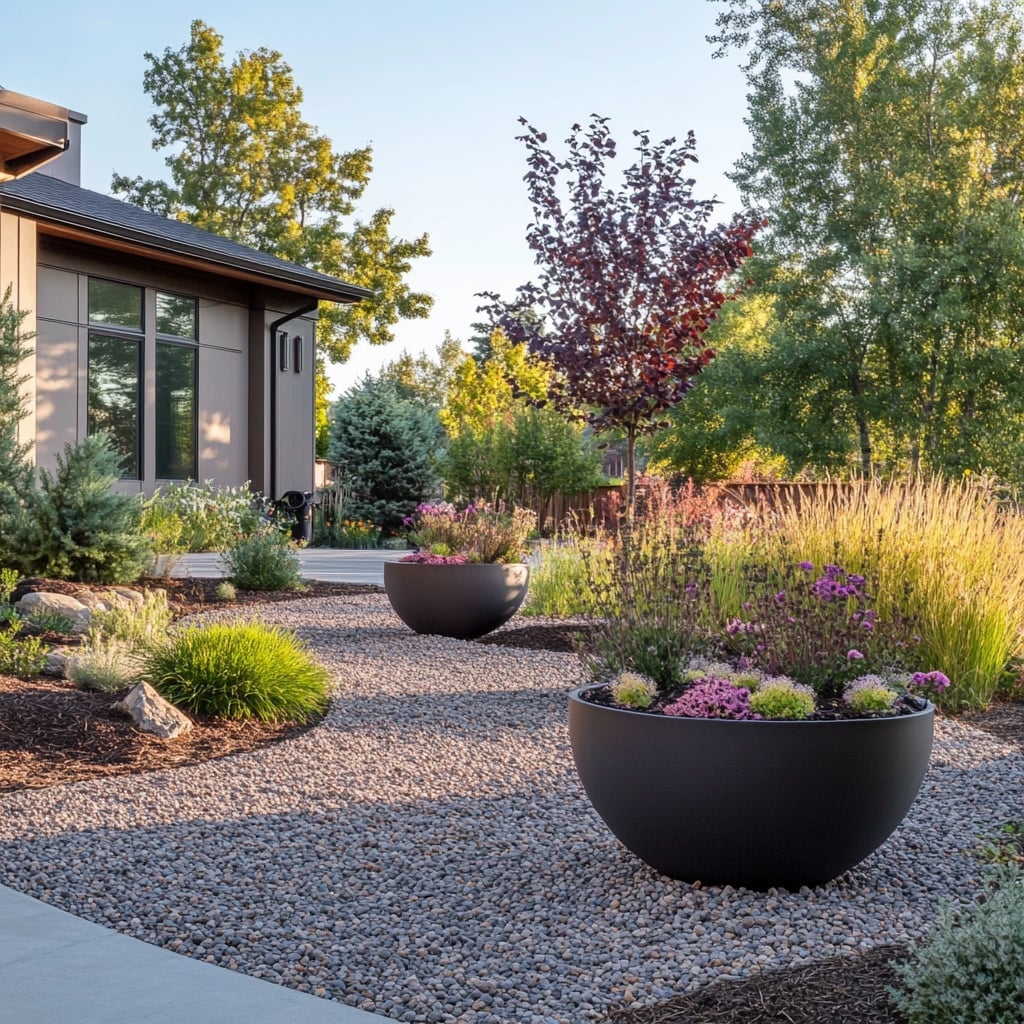
Where a flat bed of gravel can feel stark, large round planters bring a grounded, sculptural quality to the space. The hero here is the planter itself, dark and rounded, flanking a pathway to the house. Inside, ornamental grasses rise tall while flowering plants add purple tones, all set against a mix of stone, gravel, metal, and wood.
Natural daylight softens the whole scene, letting the textures do the work. The palette stays in grays, greens, purples, browns, and beiges. A single planter at the end of a path or beside a door can do the same job, anchoring the entry without needing a full border. For renters, large pots are a smart swap, giving you the same presence without permanent changes.
Succulent garden with boulders and reflective glass wall
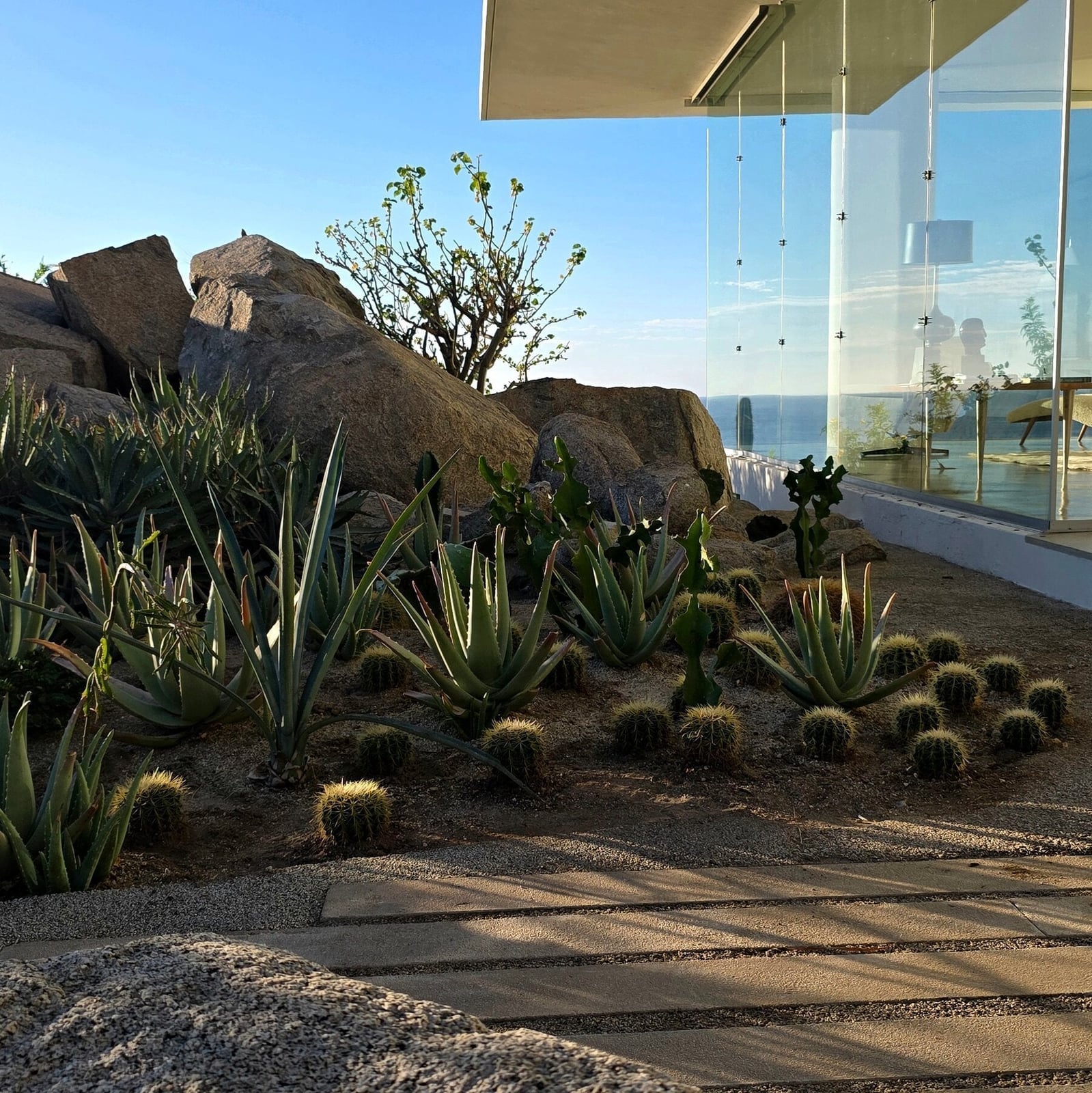
The glass wall does something unexpected here, it reflects the ocean beyond, extending the garden visually past its own boundaries. Agave plants and barrel cactus cluster around large boulders, while the pathway threads through the beds. The mix of stone, concrete, and gravel keeps the palette in greens, grays, beiges, and blues. Scale and proportion matter in a setup like this, the boulders match the weight of the glass, so neither element overwhelms the other. A reflective surface, even a simple mirror in a sheltered corner, can open up a compact yard without adding square footage.
Curved succulent beds with contrasting gravel paths
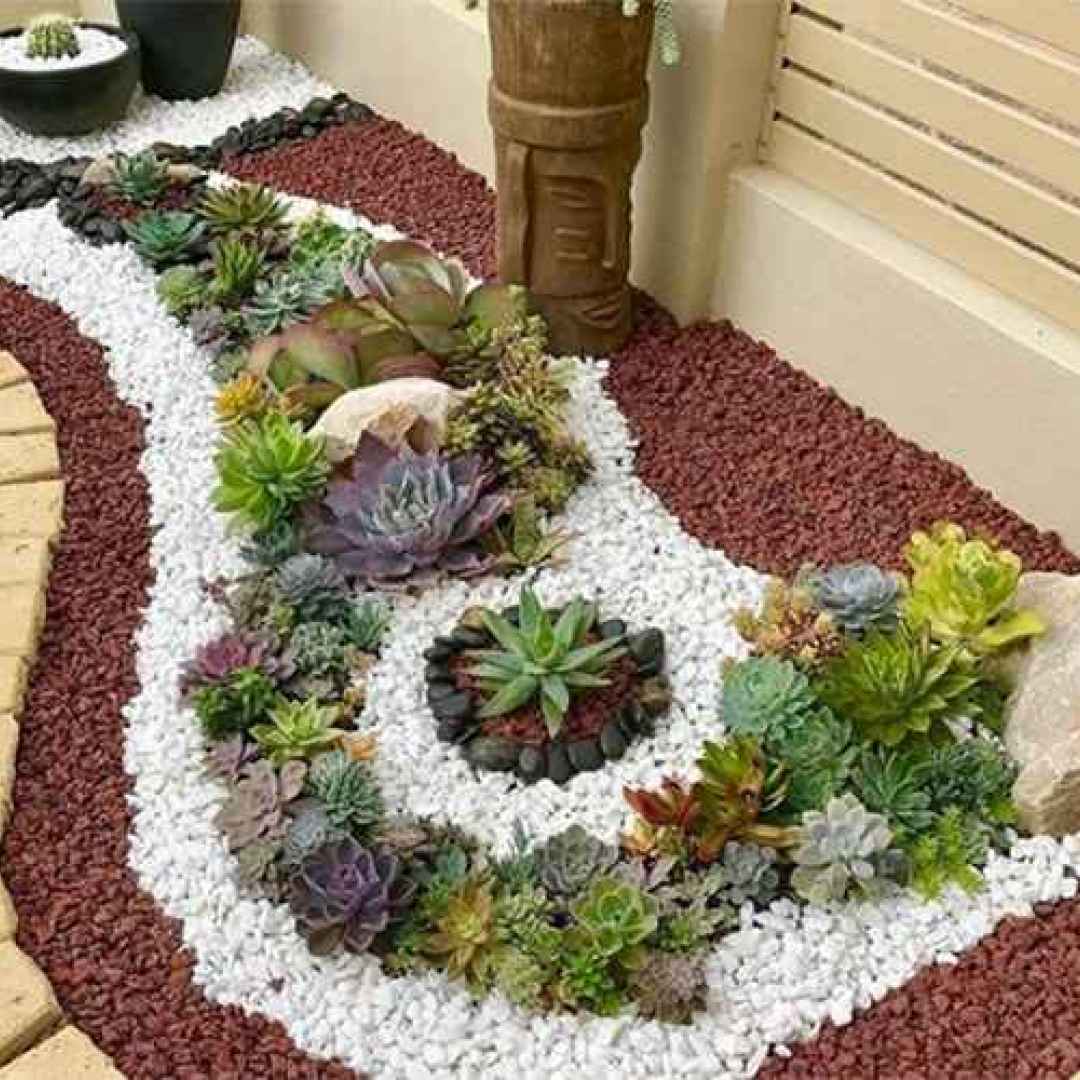
The layout here is what makes it work. Curved beds of succulents create a sense of flow, while contrasting white and red gravel paths define the route without needing hard edges. The palette pulls from greens, purples, whites, and reds, letting the plants and stones carry the color. Daylight hits the bright gravel, making the paths appear as deliberate lines. For a compact space, curved beds soften the footprint and keep the eye moving. A single curved bed along a fence line can do the same thing, breaking up a straight run without requiring a full garden overhaul.
Concrete pathway creates geometric entryway welcoming guests
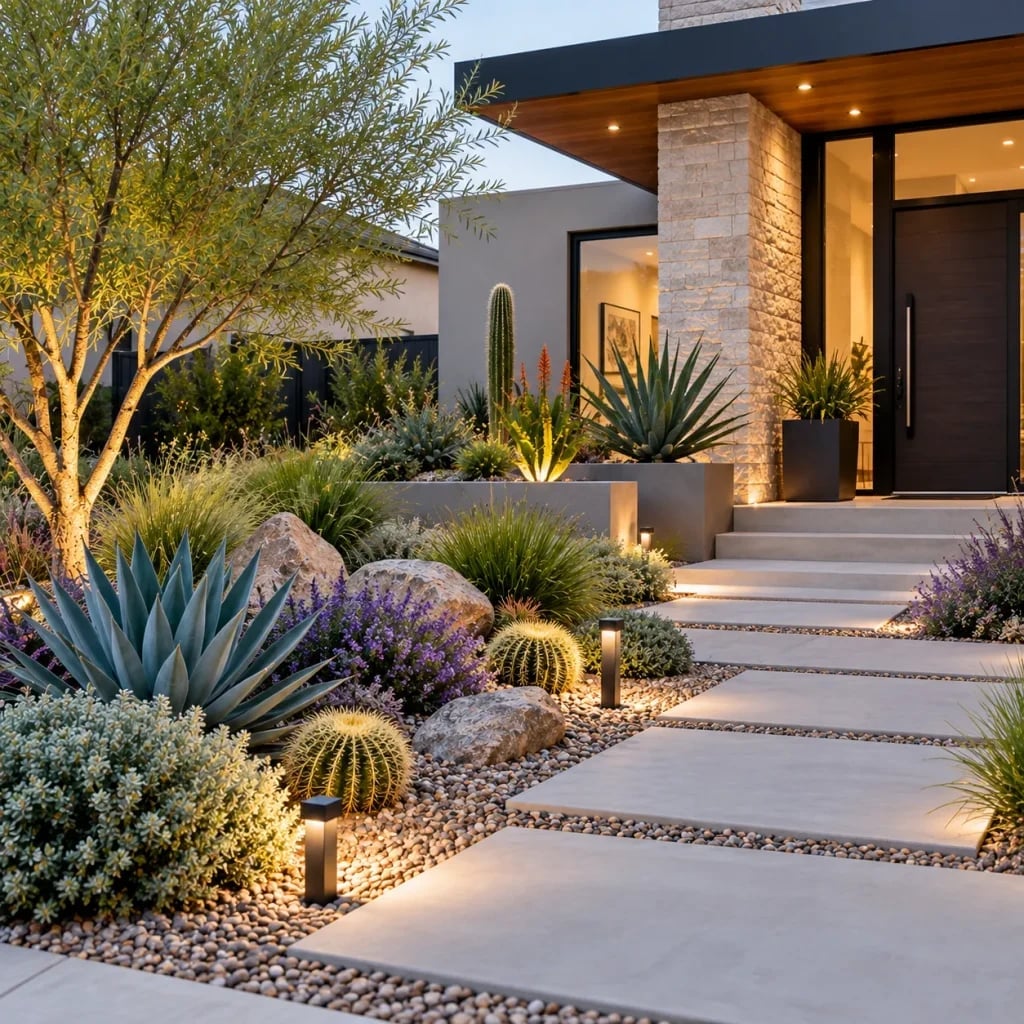
A front yard path should lead somewhere worth arriving at. Here, a geometric concrete pathway does exactly that, its clean lines guiding the eye straight to the entrance. Raised planters flank the route, filled with agave, cactus, lavender, ornamental grass, and a small tree. The palette stays in grays, greens, purples, beiges, and browns.
Path lights, uplighting, and recessed fixtures extend the welcome past sunset. The layout feels roomy because the planters lift the greenery instead of letting it spread across the walkway. For a renter safe version, line a straight concrete path with large pots in a repeating pattern. You get the same geometry without digging or permanent changes.
Agave and rocks fill layered front yard beds
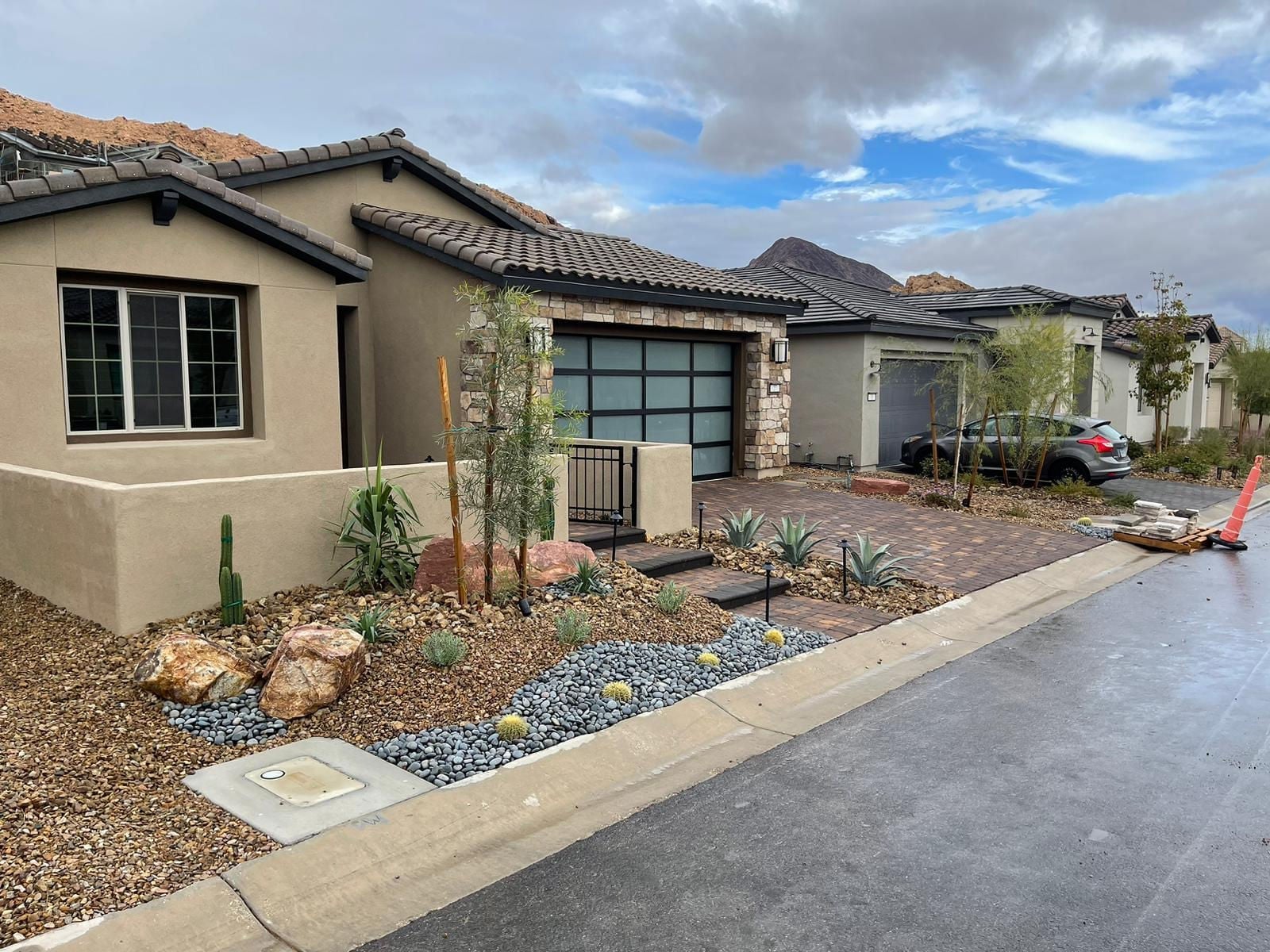
A paved driveway and layered planting beds with agave, cacti, and large rocks create a front yard that looks low-maintenance from the curb. The decorative gravel border ties the beds to the concrete and stone hardscape, unifying the tan, brown, gray, and green palette. Pathway lights add function without clutter. Use gravel as a visual bridge between plants and paved surfaces; it drains well and does not need annual replacement.
Winding gravel path through a cactus and succulent garden
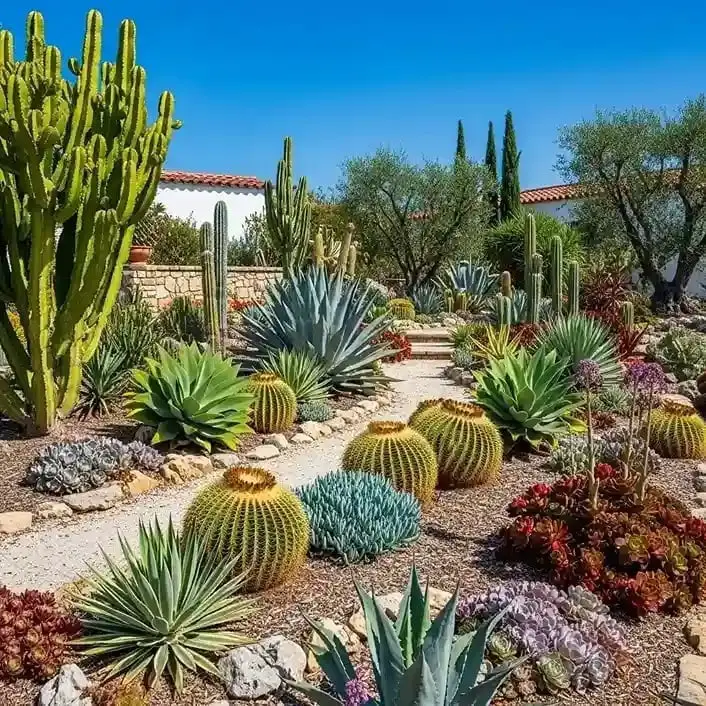
Let the curve of a backyard path follow the planting, not the other way around. Here, a winding gravel route moves past barrel cactus, agave, euphorbia, and columnar specimens, with the blue-gray and terracotta palette softening the bright sun. The path feels intentional because the plants sit in layered beds that widen and narrow as the gravel turns. For a temporary version, lay a gravel path using a border of low metal edging; it comes out without breaking the ground underneath.
Stone patio with adirondack chairs and a metal fire pit
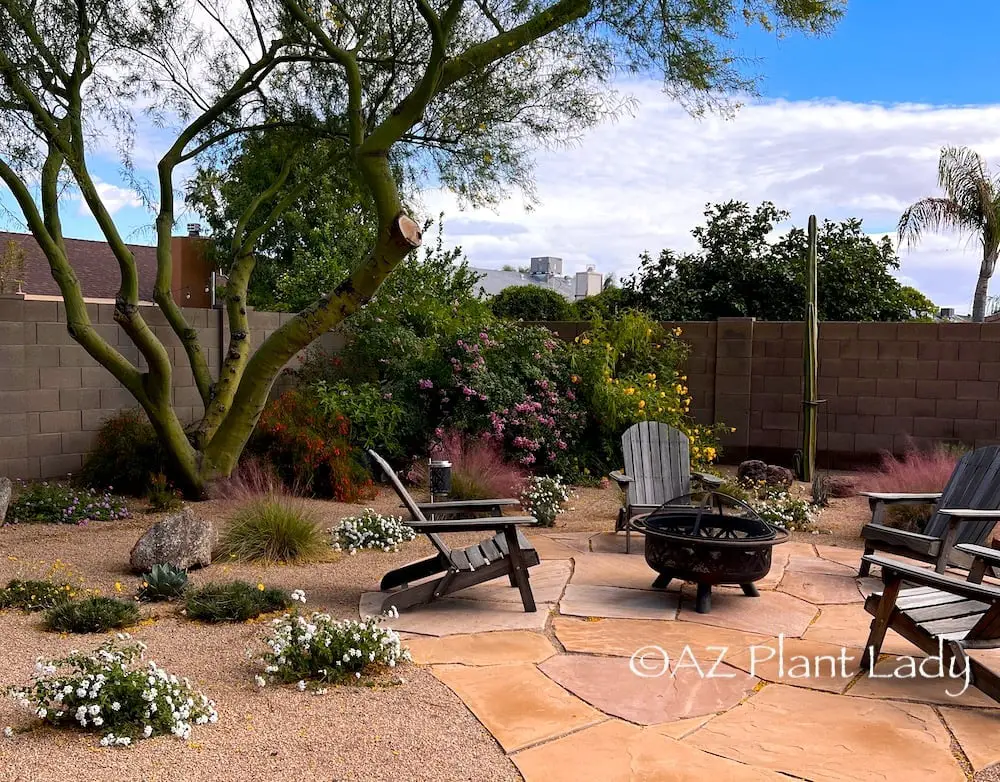
A desert modern patio with a metal fire pit and Adirondack chairs reads more like a living room than a campsite. The stone surface, large desert tree, and layered plantings in tan, green, and pink make the seating area feel anchored rather than dropped in. The difference between this and a typical fire pit setup is the surround: instead of bare gravel or concrete, the patio uses natural stone in irregular shapes that match the desert palette.
Red shrubs contrast with saguaro cacti in native planting
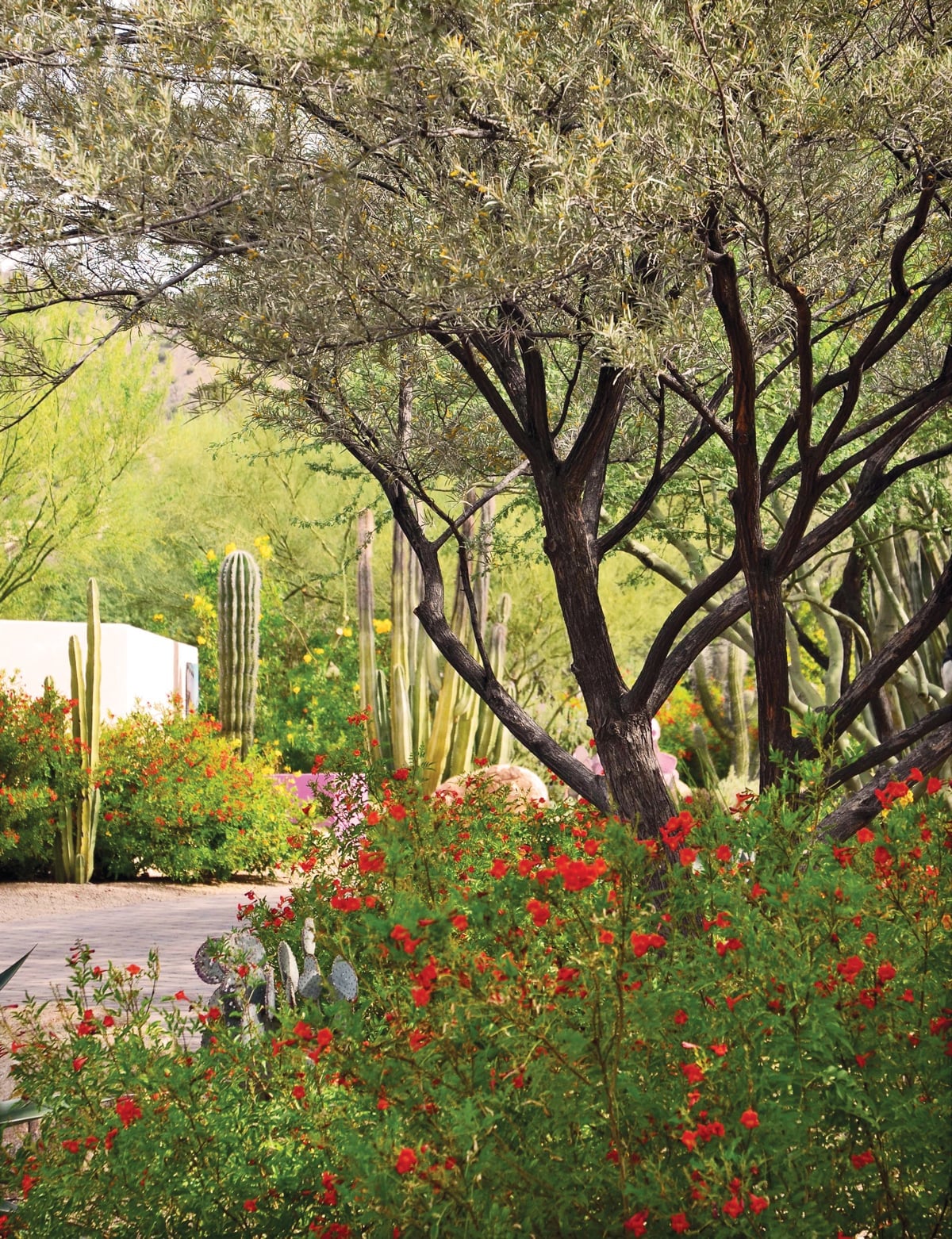
The palette here works because the red flowering shrubs sit in front of the saguaro and prickly pear cactus, not scattered throughout. That placement keeps the green and red distinct without chaos. The stucco wall and wood accents in the background stay neutral, letting the yellow and white blooms in the shrubs act as highlights. A good ratio for a colorful desert bed is one vivid plant per five green ones, clustered near the front edge.
Minimalist pathway with tall columnar cacti and stucco walls
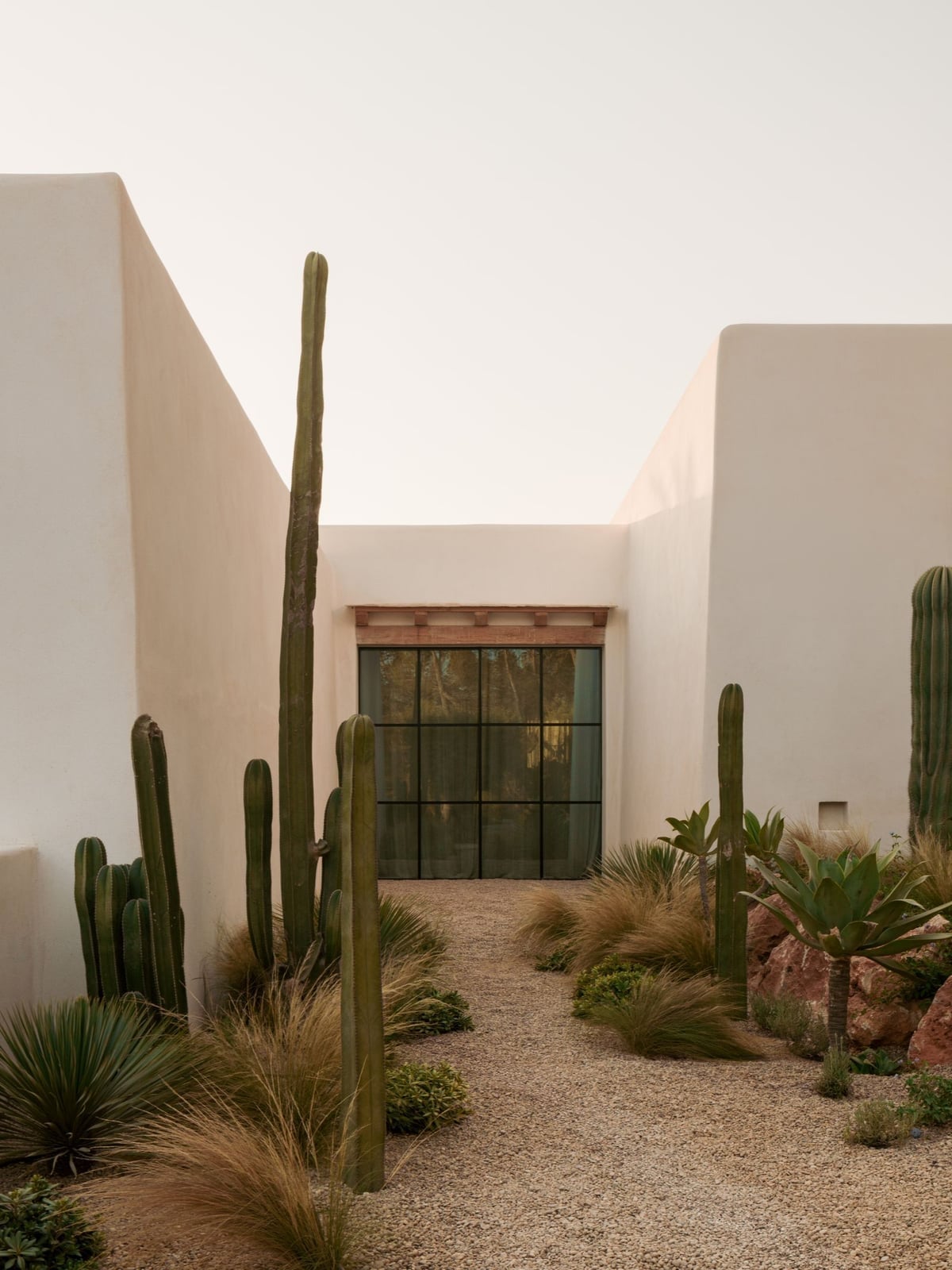
This is a garden where the plants do the architecture. Tall columnar cacti line a gravel path against warm beige stucco walls, with agave and ornamental grasses filling the lower layer. The glass elements and wood accents add texture without breaking the clean lines. What defines the style is the vertical repetition: the cacti are spaced evenly, so they form a colonnade instead of a random cluster. A single shorter plant would break that rhythm.
Saguaro cacti against stucco wall with curved concrete patio
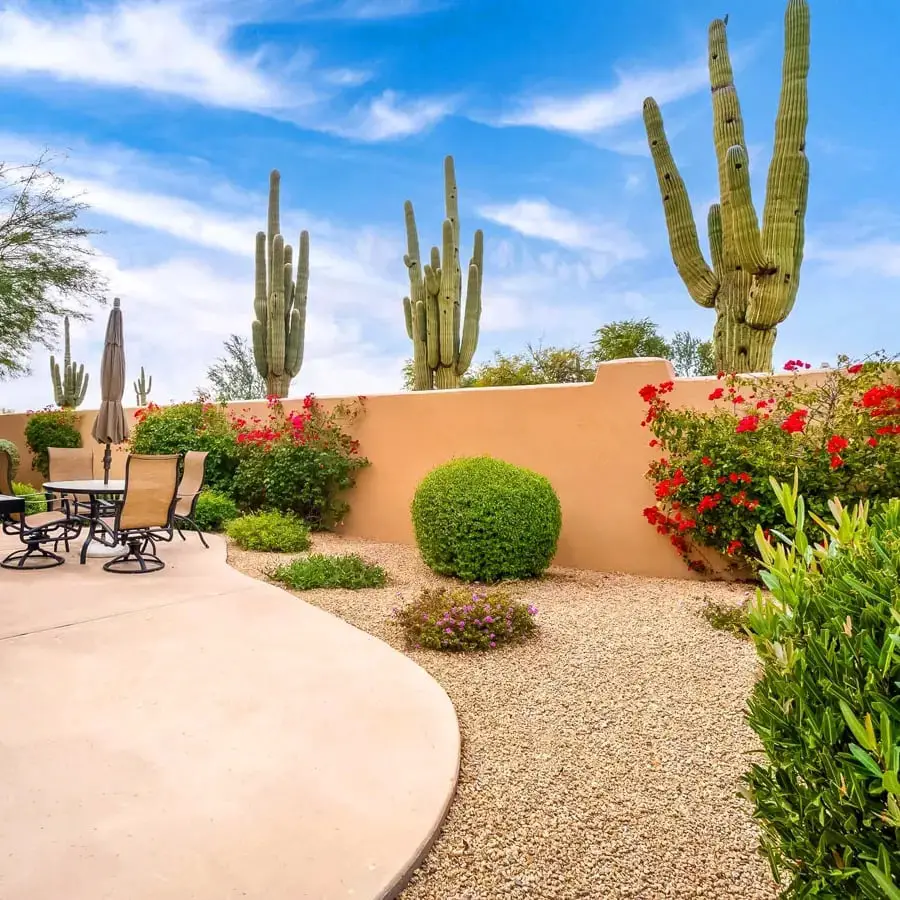
A curved concrete patio softens the line between hardscape and planting bed, making a roomy backyard feel planned. The saguaro cacti stand against a stucco wall, their vertical form drawing the eye up past the patio furniture and umbrella toward the blue sky. Gravel covers the ground around them, a low-maintenance surface that lets rainwater reach the roots of the flowering bushes below.
The layout uses the wall as a backdrop, the curve of the concrete as a guide, and the tall cacti as natural punctuation. Tan and green dominate the palette, with red blooms and blue sky adding contrast. Bright daylight casts short shadows, keeping the space open and uncluttered. To recreate it, look for one large saguaro placed off-center against a solid wall, with the patio curving gently around it.
Rammed earth wall with saguaro and columnar cacti
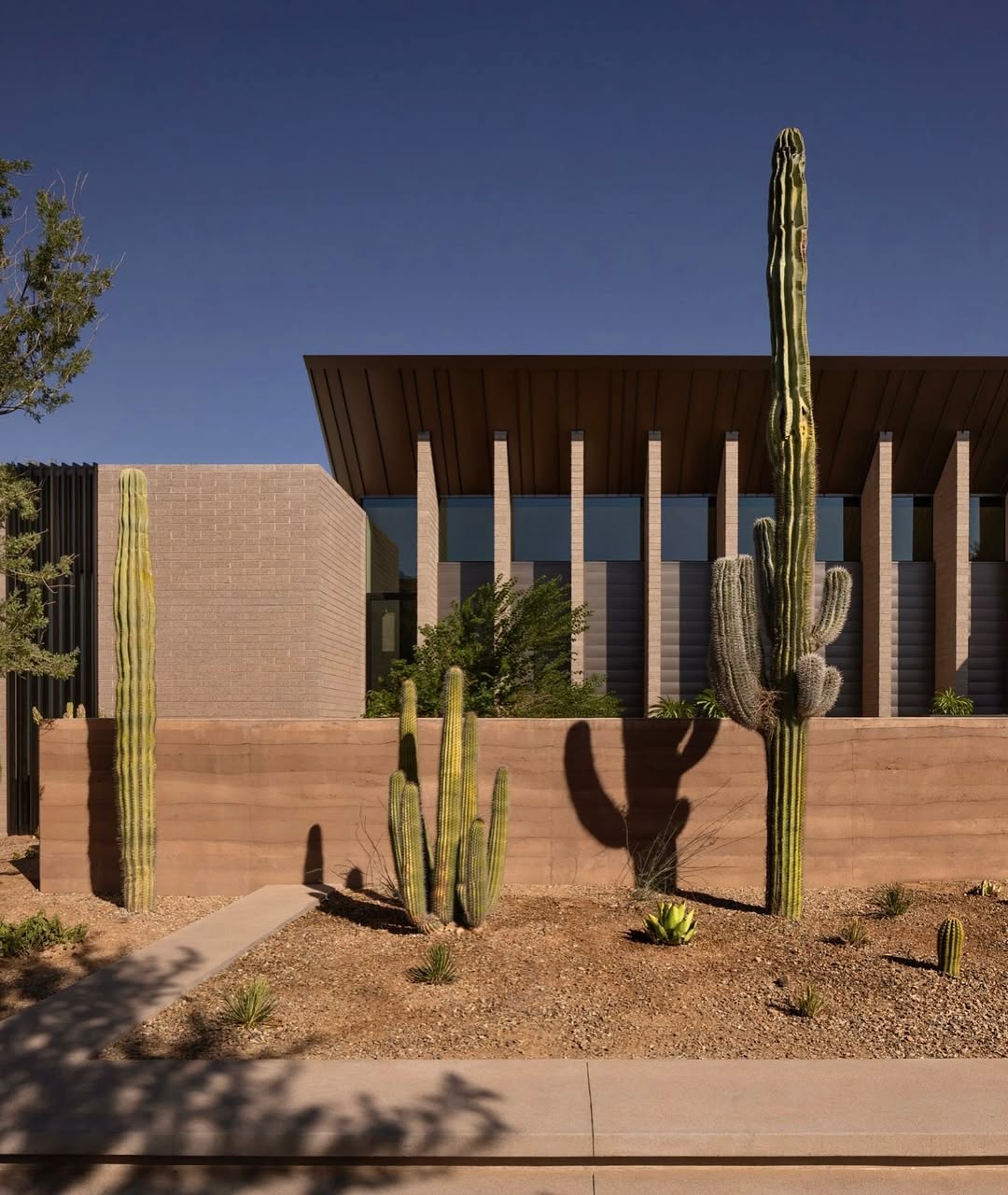
A rammed earth wall brings texture and warmth that standard stucco cannot match, its layered tan and brown strata echoing the desert floor. In this spacious backyard, a pathway of concrete and gravel leads past a tall saguaro and a cluster of columnar cacti toward the wall, with agave plants filling the lower layer. Strong shadows from bright daylight emphasize the wall’s horizontal lines, while the vertical cacti break that rhythm. The palette stays in warm earth tones and green, with a blue sky above. For a modern desert landscape with rammed earth wall and cacti, keep the plant arrangement simple: let the wall be the texture and the cacti be the silhouette.
Vast red sand dunes under sunset hues
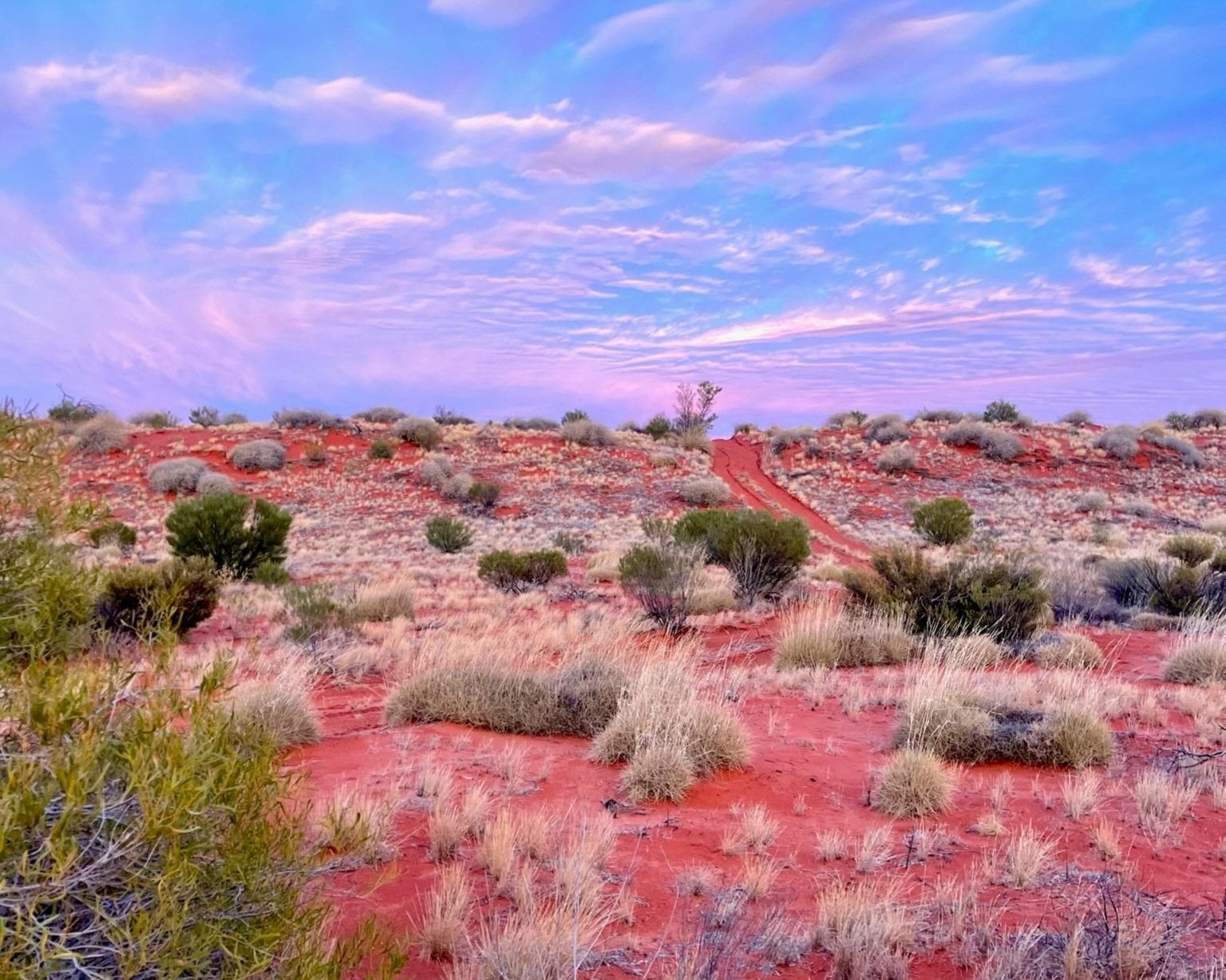
When a yard backs onto open terrain, let the natural view guide the planting. The red sand dunes here roll in undulating curves under a sunset sky, with native shrubs and dry grasses scattered along a winding dirt path. The palette shifts from red and pink in the sand to green and beige in the vegetation, with blue overhead. No irrigation system or imported soil is needed for this kind of natural desert landscape with red sand dunes and native shrubs; the plants that thrive here are the ones that already grow in the area. To recreate it, look for: working with the existing topography and choosing plants that tolerate the local rainfall and soil type.
Terraced planting beds with pool and mountain backdrop
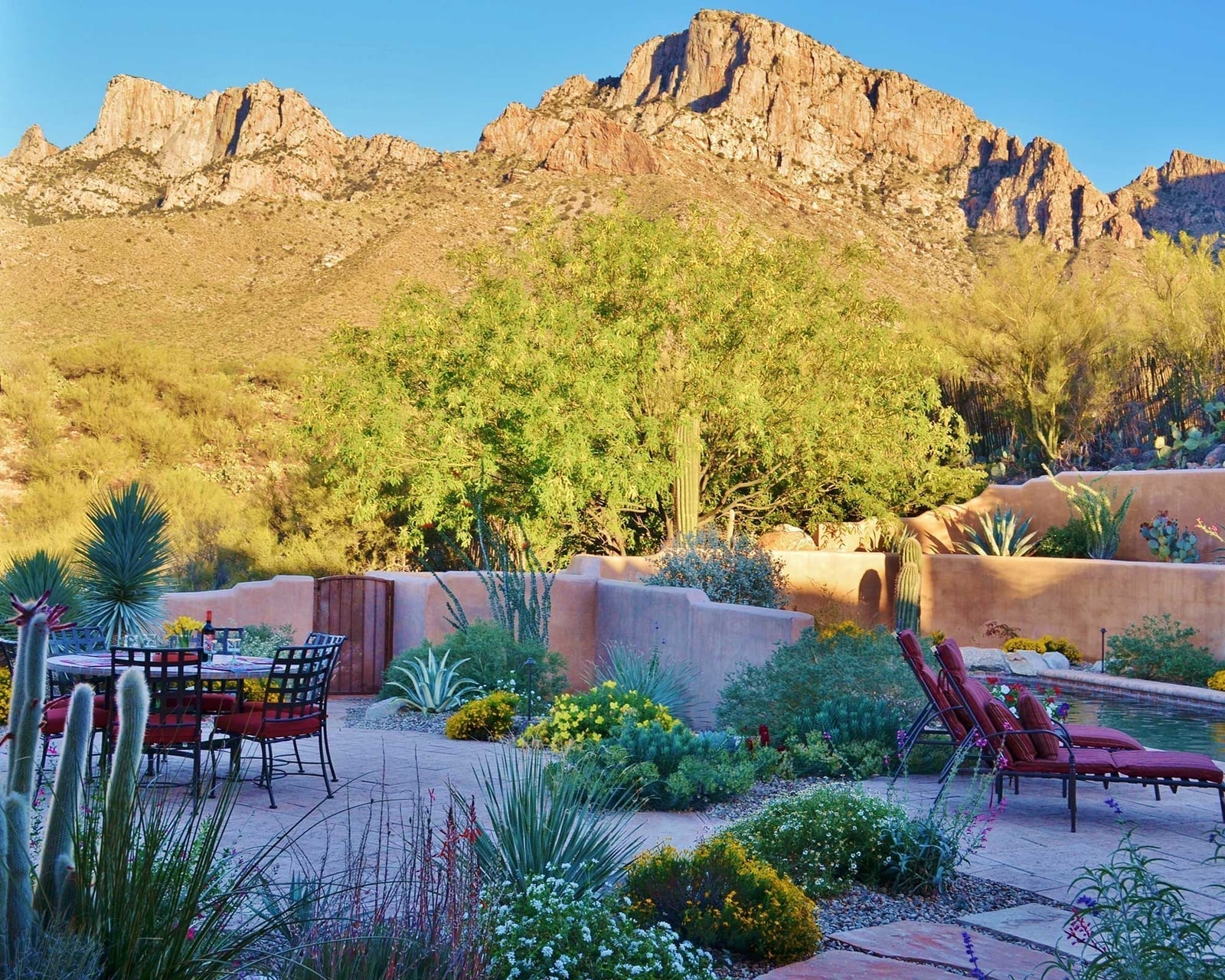
A flat patio can feel exposed, but terraced planting beds add depth without blocking the view. In this roomy setup, the paving sits at pool level while raised stone beds hold desert plants that step up toward a mountain backdrop. The dining set and lounge chairs stay on the flat surface, while the greenery frames the horizon. Natural sunlight shifts across the terraces during the day, catching the red and yellow blooms against tan stucco walls.
A modern desert patio with terraced planting beds and pool works best when the tallest plants go on the highest terrace and the lowest ones stay near the seating area. This keeps the sightline open from a seated position. Metal and wood accents in the furniture tie back to the warm stone tones, creating a palette that feels cohesive from any angle.
Weeping tree and succulent garden with wood chip mulch
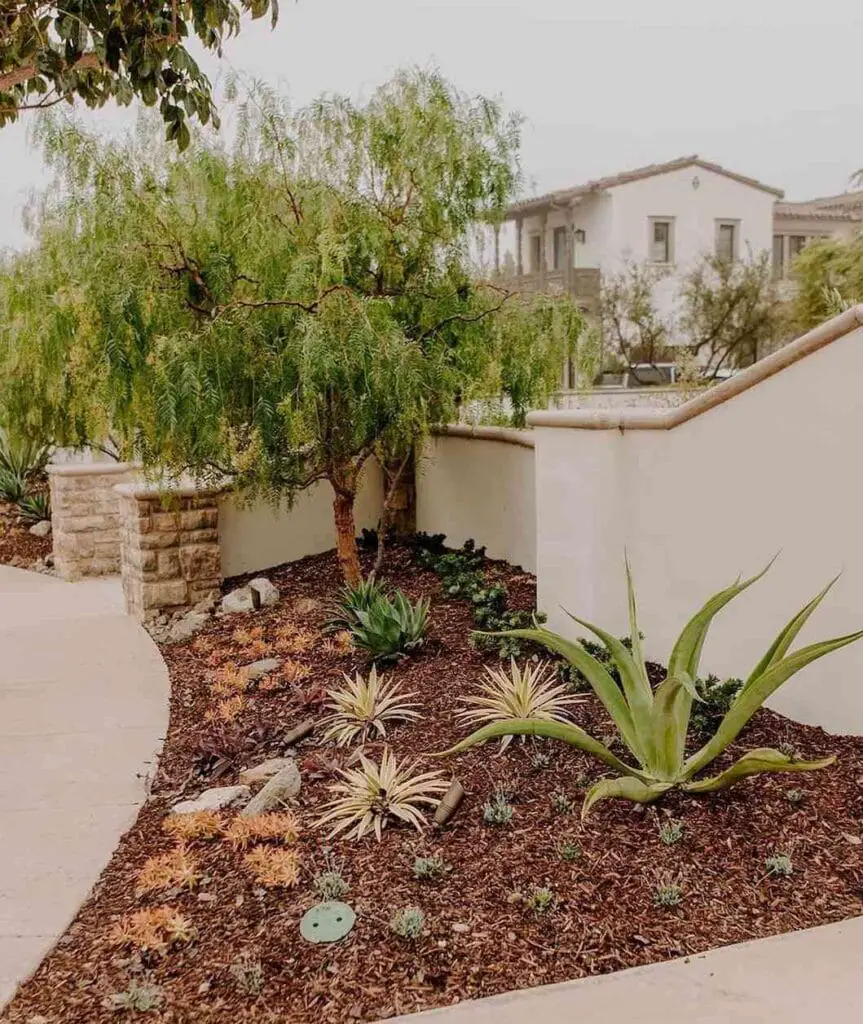
A weeping tree introduces a soft, drooping silhouette that contrasts with the upright spikes of agave and other succulents. In this backyard, the tree anchors a curving pathway that winds through raised beds filled with green and orange-hued plants. Wood chip mulch covers the soil around them, a practical choice that retains moisture and suppresses weeds without reflecting heat the way gravel can. Stone edging keeps the mulch contained and defines the bed lines. For a modern desert garden with weeping tree and succulents, choose a tree that stays small enough to match the bed scale and let the pathway curve follow the tree’s natural spread rather than forcing a straight line.
Raised concrete planters with diverse cacti and artificial turf
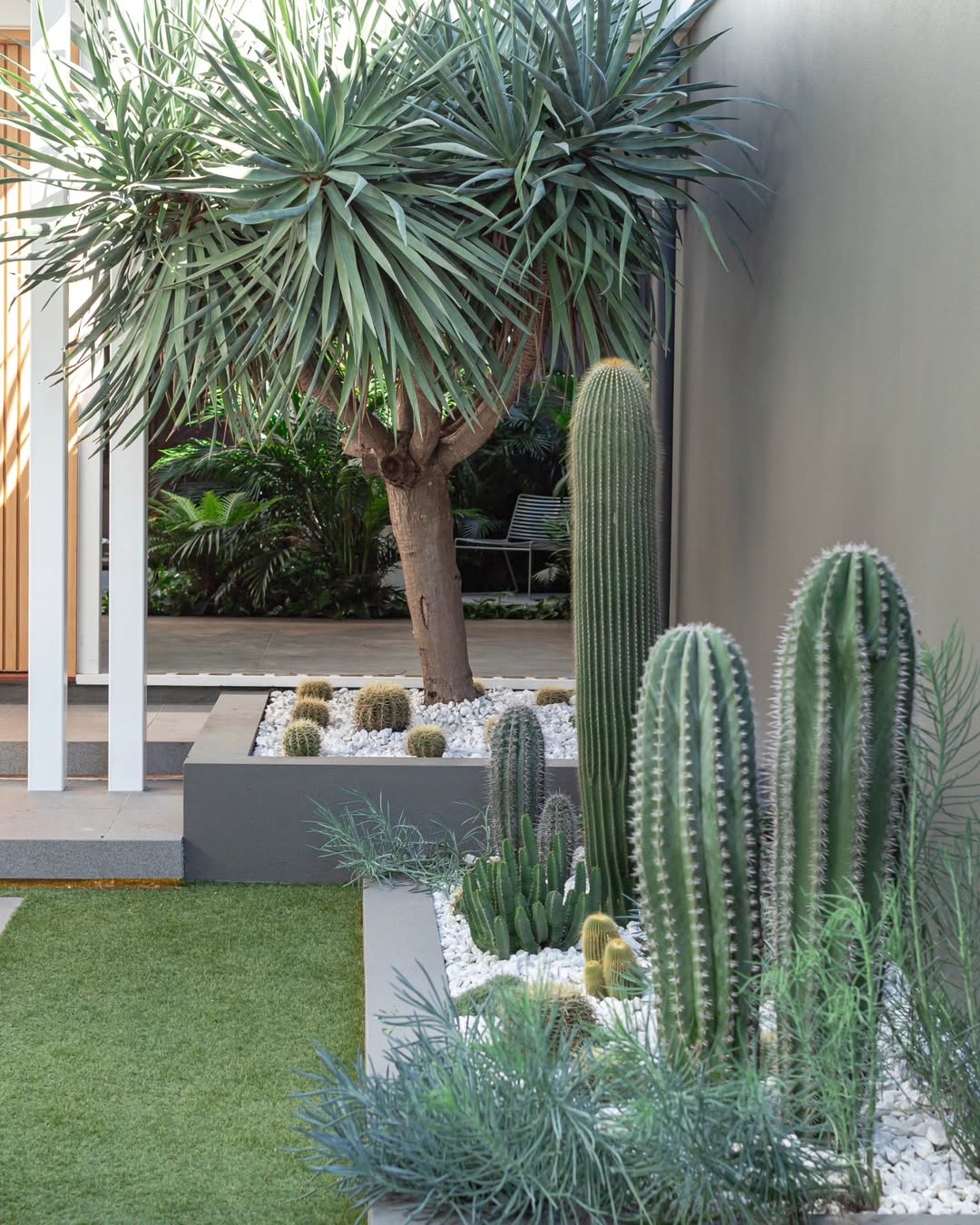
A modern backyard uses raised concrete planters to group a collection of cacti by shape, not just species. Tall columnar types stand behind round, spherical ones, with a dragon tree adding height at one end. Green, gray, and white keep the palette simple, so the variety of cactus shapes stands out. Artificial turf fills the ground space between planters, giving the whole yard a clean, low-maintenance surface that works well for small outdoor areas. The layout keeps the cacti garden as the central feature, with the concrete planters and turf staying simple around it. This setup suits anyone who wants a sculptural garden without the weekly watering that a lawn demands.
Dry creek bed with large boulders and agave plants
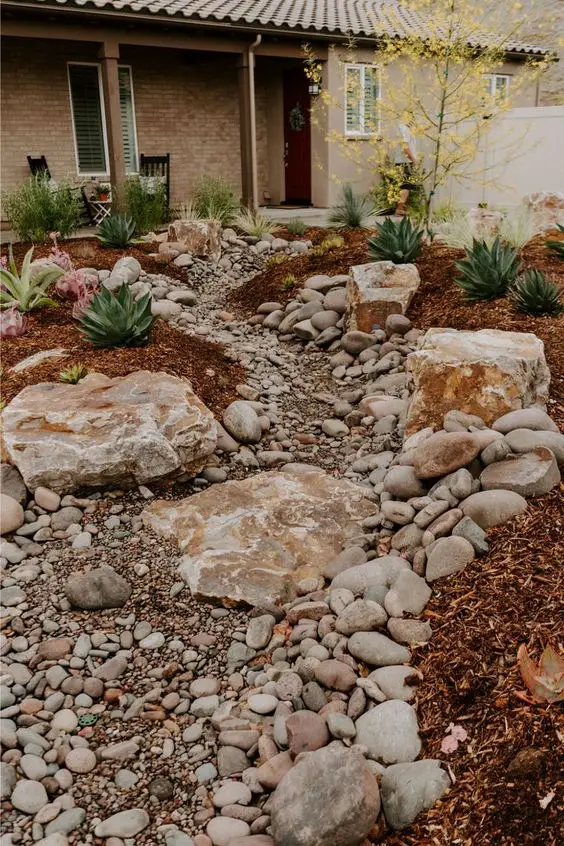
A dry creek bed offers a natural drainage solution that looks more intentional than a standard gravel path. This front yard design uses a curving bed of river rocks and mulch, framed by large boulders that anchor the space. Agave plants add green structure along the edges, while the tan, gray, and pink tones in the stone keep the palette grounded in the desert landscape. The boulders break up the flow of the creek bed, creating visual stops that let the eye rest.
For renters, a dry creek bed is one of the easier landscape features to install without permanent changes. The rocks and mulch sit on top of the soil, so they can be raked away and removed when you move out. Large boulders may require some muscle or help to position, but they do not need concrete footings or digging. The whole setup directs rainwater away from the house while adding texture that a flat gravel bed cannot match.
Organic adobe dome architecture with round cacti
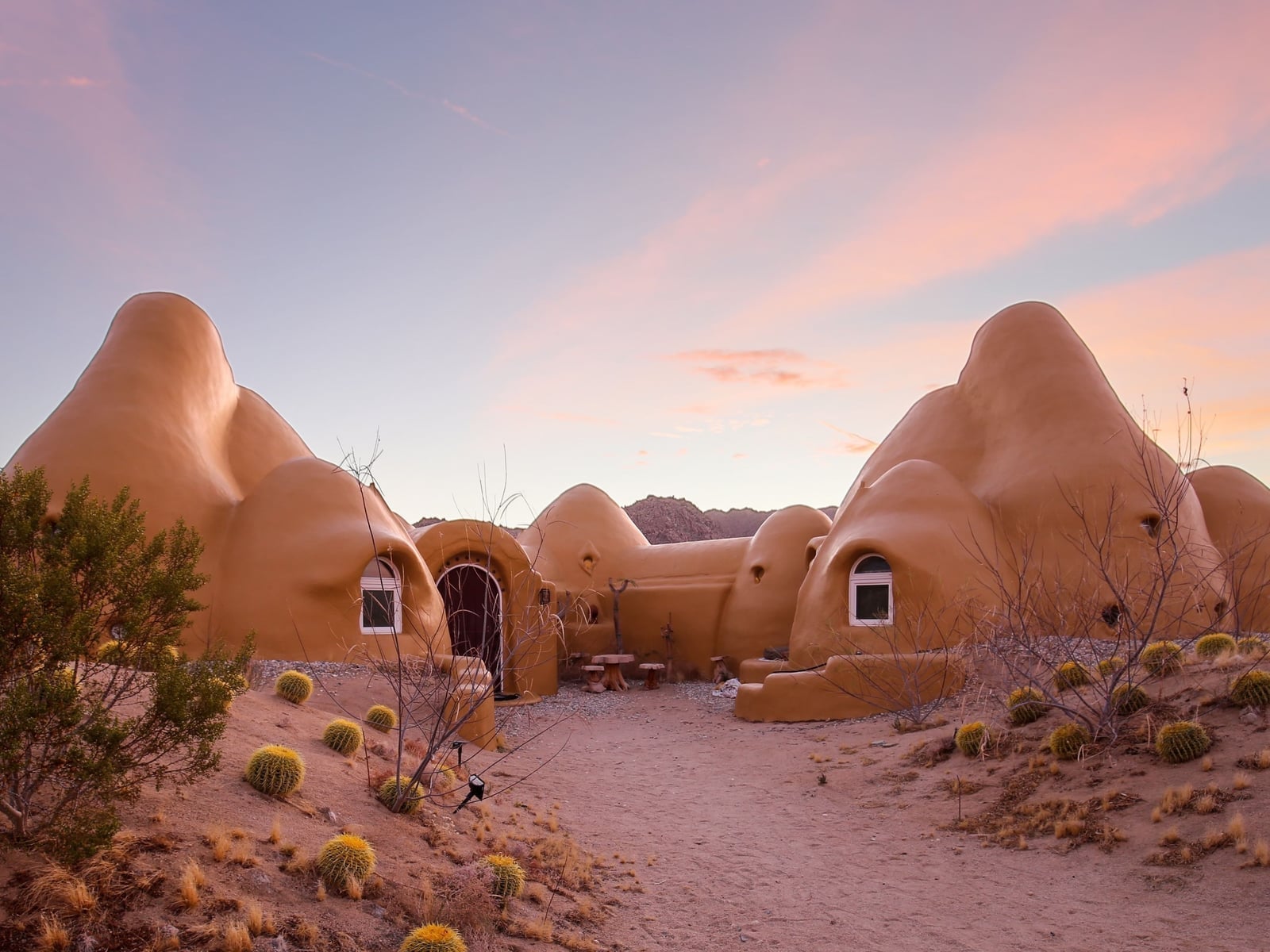
An adobe dome courtyard proves that desert landscaping does not need straight lines to feel cohesive. The rounded building forms echo the shape of the round cacti planted along the central pathway, while the tan and beige walls pick up the pink tones in the stone table and benches. Subtle ground lights come on at twilight, softening the transition from the warm adobe to the blue evening sky. What breaks the organic feel is the straight pathway leading to the arched doorways. A curved path or stepping stones would have kept the whole courtyard in the same flowing rhythm as the architecture.
Final Thoughts
These 28 looks prove that desert landscaping can be as varied as any other garden style. The common thread is working with the environment: choosing plants that thrive in the heat, using stone and gravel to define spaces, and letting texture and form carry the visual weight. Before you dig, check your USDA zone to make sure your plant picks are happy where you live. A little planning goes a long way toward a garden that feels settled from day one.